Water Hammer and Pressure Transients in Pumping Systems: Causes, Joukowsky Equation & Prevention
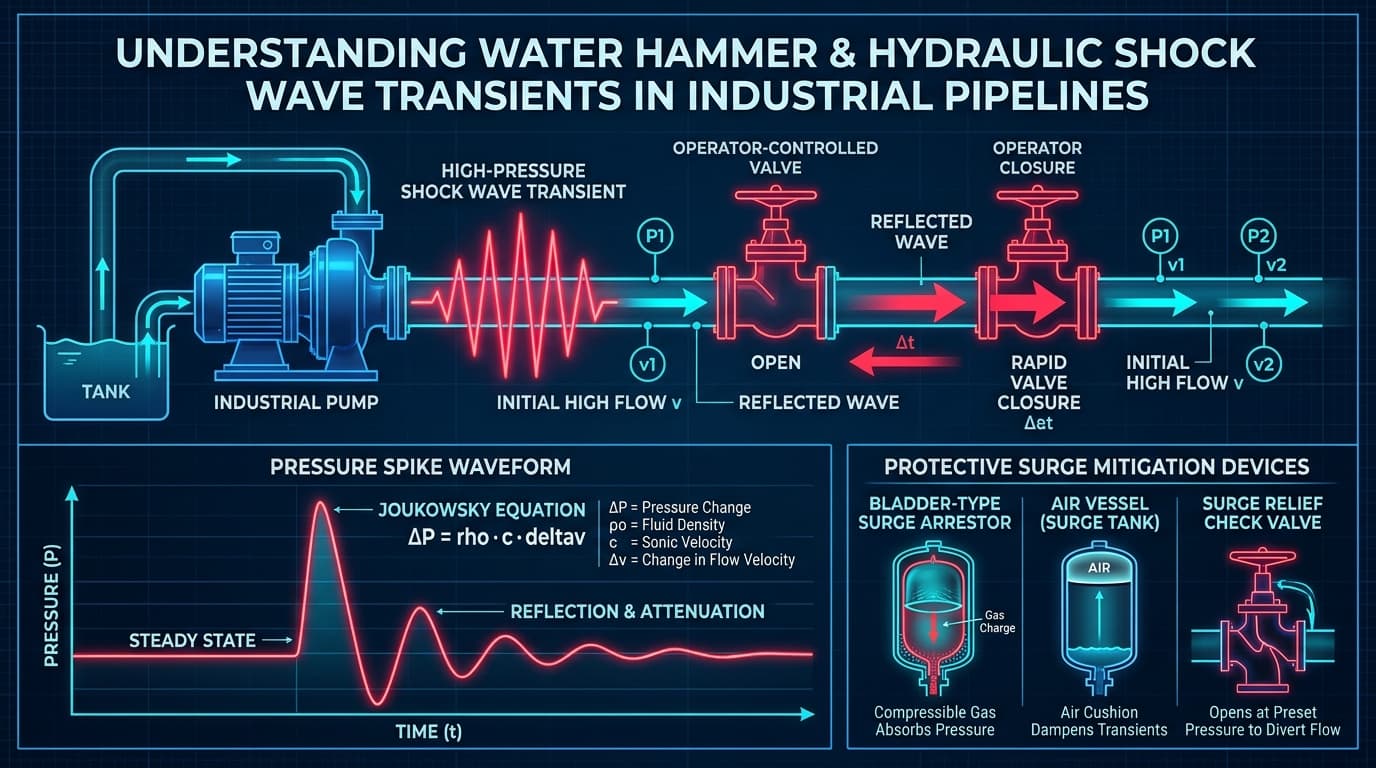
Figure 1: Pipeline pressure spike transient propagation following rapid valve closure, acoustic wave oscillation waveform, and surge arrestor protection vessels.
Catastrophic Plant Risk
A sudden power blackout or rapid valve closure can transform the momentum of a thousand tons of moving liquid into an acoustic shockwave exceeding 50 to 100 bar (700 to 1,500 PSI) above operating pressure. If unmitigated, water hammer ruptures pipe welds, tears pipe hangers off ceiling beams, and shatters pump casings.
1. What is Water Hammer? The Sonic Shockwave Phenomenon
Water is essentially incompressible (bulk modulus of elasticity K ≈ 2.19 GPa). When fluid is flowing through a pipe at high speed, it possesses immense kinetic momentum (E_k = ½ m v^2).
If a valve downstream is closed suddenly, the fluid immediately touching the valve face is brought to a dead stop. But the liquid column further upstream does not know the valve has closed! It keeps hurtling forward at full velocity, slamming into the stopped fluid like cars in a multi-vehicle highway pileup. The kinetic energy converts into elastic strain energy, creating a high-pressure shockwave that races backward toward the pump at the speed of sound!
2. The Joukowsky Equation: Calculating Maximum Pressure Rise
Formulated in 1898 by Russian physicist Nikolay Joukowsky, the maximum theoretical pressure surge (Δ P) resulting from instantaneous valve closure is:
Where:
- Δ P: Pressure spike surge (Pascals)
- ρ: Fluid density (kg/m³)
- c: Acoustic wave propagation speed through the liquid-pipe system (m/s)
- Δ v: Change in flow velocity brought to a halt (m/s)
- g: Acceleration due to gravity (9.81 m/s²)
In carbon steel water pipes (where c ≈ 1,000 m/s), bringing fluid moving at just 1.0 m/s to an abrupt stop produces an instantaneous pressure spike of 10.0 bar (145 PSI)! If fluid was flowing at 3.0 m/s, the pressure spike tops 30.0 bar (435 PSI) on top of normal operating pressure!
3. Acoustic Wave Speed (c) in Elastic Industrial Pipelines
The speed of the pressure wave (c) is not simply the speed of sound in pure water (1,480 m/s), because the pipe wall flexes elastically under pressure, dampening the wave speed:
Typical wave speeds in industrial installations:
- Heavy Carbon Steel Pipe: 1,000 to 1,200 m/s
- Ductile Iron Pipe: 1,050 to 1,150 m/s
- PVC / CPVC Plastic Pipe: 300 to 450 m/s (much lower wave speed, meaning smaller Joukowsky spikes, but lower pipe burst strength)
- HDPE Pipe: 200 to 350 m/s
4. Sudden Pump Shutdown & Emergency Power Outage Transients
While valve closures cause an initial positive pressure spike (upsurge), a sudden pump shutdown during an electrical blackout causes an initial negative pressure wave (downsurge)!
When power cuts, motor driving torque drops to zero. The impeller rapidly decelerates within 1 to 2 seconds due to fluid drag. But the fluid column in the long discharge line continues coasting downhill or forward under inertia. Immediately downstream of the pump check valve, pressure plunges toward zero absolute!
5. The Deadly Vacuum: Liquid Column Separation & Re-Join Collapse
If the downsurge pressure drops to fluid saturation vapor pressure (approx -1.0 bar gauge), the liquid column separates into two pieces with a growing vapor pocket between them!
Eventually, gravity and downstream reservoir backpressure halt the forward coast of the water column. The water reverses direction and rushes backward down the pipe. When this massive reversed liquid slug slams into the closed pump check valve and collapses the vapor void, the resulting secondary shockwave can exceed 3 to 5 times the normal design pressure, shattering the discharge manifold!
6. Surge Mitigation Equipment: Air Vessels, Bladders & Relief Valves
Bladder Surge Vessels
A pressure vessel pre-charged with nitrogen gas separated from the fluid by an elastic butyl or EPDM rubber bladder. When pressure surges, liquid enters and compresses the gas cushion. During downsurges, gas expands to feed water into the line, preventing vacuum separation.
Air Release & Vacuum Breaker Valves
Mounted at high elevation summits along the pipeline. If a negative downsurge occurs, the valve snaps open to admit large volumes of atmospheric air, cushioning the vacuum. When the column returns, it vents air slowly through an orifice to prevent slam.
Fast-Opening Surge Anticipator Valves
Hydraulically actuated valves that sense the initial downsurge (loss of power) and open before the high-pressure return wave arrives, diverting the destructive wave harmlessly back into the suction reservoir.
7. Check Valve Slam: Why Swing Checks Fail and What to Use Instead
Traditional swing check valves rely on gravity to swing a heavy flapper closed. In high-head systems, by the time the flapper swings shut, fluid has already reversed direction and is flowing backward at 1.0 to 2.0 m/s. The flapper slams into its metal seat with explosive force, causing loud "water hammer thuds" and cracked hinge pins.
The Modern Solution: Nozzle-Style Non-Slam Check Valves
Specify axial nozzle check valves with internal spring assistance. The spring begins closing the disc the microsecond forward velocity reaches zero, achieving complete tight shutoff before backward flow can even initiate!
8. Step-by-Step Surge Calculation for a 2,000m Pipeline
Pipeline Parameters:
Pipeline Length (L): 2,000 meters | Wave Speed (c): 1,050 m/s
Normal Flow Velocity (v): 2.2 m/s | Operating Pressure (P_0): 6.0 bar(g) (600,000 Pa)
T_c = (2 · L) / c = (2 · 2,000) / 1,050 = 3.81 seconds
(Any valve closing faster than 3.81s is considered instantaneous!)
ΔP = 1,000 kg/m³ · 1,050 m/s · 2.2 m/s = 2,310,000 Pa (23.1 bar / 335 PSI)
P_peak = P_0 + ΔP = 6.0 bar + 23.1 bar = 29.1 bar gauge (422 PSI)!
9. Frequently Asked Questions
How do Variable Frequency Drives (VFDs) eliminate water hammer during routine stops?
By programming a deceleration ramp (e.g. 15 to 30 seconds), the VFD gradually reduces motor rotational speed, bleeding off fluid momentum progressively without triggering an acoustic wave. However, remember that VFDs provide zero protection during a sudden electrical utility blackout!
Can water hammer occur in closed loops without valves?
Yes. If an air bubble is trapped at a high point in a piping loop, starting a pump quickly can compress that air pocket like a spring. When the air pocket re-expands, it creates violent pressure oscillations and pipe shaking.
Zylofy Thermal & Fluid Dynamics Engineering Group
Authored and reviewed by pipeline hydraulic transient engineers and surge suppression specialists with consulting expertise in municipal water distribution and chemical plant safety audits.