Pump Impeller Trimming: Practical Calculation, Diameter Limits & BEP Impact
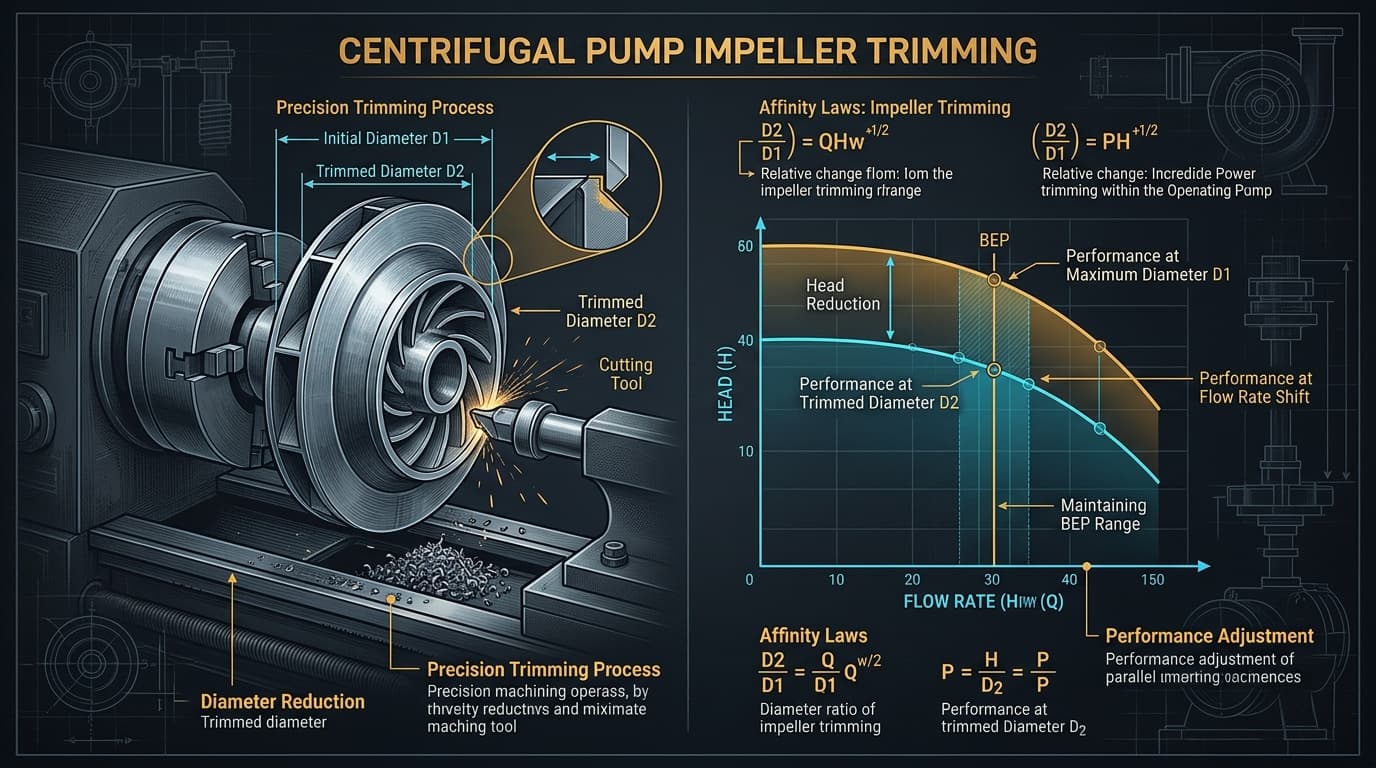
Figure 1: Industrial lathe machining of a closed radial impeller, reducing outer diameter from D_1 to D_2 to permanently adjust developed head and shaft brake horsepower.
The Permanent Solution for Oversized Pumps
In industrial plants, pumps are frequently oversized by 20% to 50% due to conservative engineering safety factors. Operators frequently throttle the discharge control valve to choke flow, wasting megawatts of electrical energy. Impeller trimming physically reduces the outside blade diameter on a machine lathe, permanently right-sizing the pump, stopping control valve cavitation, and reducing electrical bills for a one-time machining cost of under $500!
1. What is Impeller Trimming? When Permanent Modification Makes Sense
Centrifugal pump casings are designed by manufacturers to accommodate a family of impeller diameters (e.g. from a maximum diameter of 250 mm down to a minimum diameter of 190 mm within the exact same volute casing).
While Variable Frequency Drives (VFDs) are ideal when process demand changes from hour to hour, a VFD costs thousands of dollars and requires ongoing cooling and maintenance. If your process flow is steady and you simply have a pump that produces 15 meters of excess head, chucking the impeller on a lathe and trimming 15 mm off the outside diameter permanently eliminates the excess pressure with zero ongoing complexity!
Calculate Your Ideal Operating Duty Point
Model your piping system head curve on the Zylofy dashboard to find your exact required head and determine how much diameter trim is needed.
2. Modified Affinity Laws for Impeller Diameter
In standard textbooks, the classical affinity laws for changing impeller diameter (D) at constant rotational speed are written as:
3. Why Theoretical Laws Overpredict Head Reduction in Practice
Because blade vane overlap decreases and the clearance between the impeller tip and the stationary volute casing cutwater increases, head drops more steeply than (D_2 / D_1)^2.
In practical rotating equipment engineering, we use the Empirical Stepanoff Modified Formula:
Where the empirical exponent is typically between 2.2 and 2.5 rather than 2.0. Always consult manufacturer certified impeller trim curves whenever available before turning metal!
4. The 15% to 20% Maximum Trimming Rule (API 610 Standards)
Can you take a 300 mm impeller and machine it down to 150 mm? Absolutely not!
Per API 610 (12th Edition) Section 6.1.6 and Hydraulic Institute standards:
- Maximum Allowable Trim: 15% to 20% of maximum design diameter (e.g. from 250 mm down to a minimum of 200 mm to 212 mm).
- Minimum Continuous Vane Overlap: The trailing edge of one vane must overlap the leading edge of the adjacent vane by at least 15° to guide fluid smoothly.
- Future Trim Margin: API 610 specifies that rated impellers must be capable of at least a 5% further diameter reduction without exceeding minimum limits, and the casing must be capable of accepting an impeller at least 5% larger for future capacity debottlenecking.
5. Impact on Hydraulic Efficiency and Best Efficiency Point (BEP)
When an impeller is trimmed:
The flow rate at which the pump achieves maximum efficiency shifts linearly to lower flow: Q_BEP,2 = Q_BEP,1 · (D_2 / D_1).
Because clearance between impeller discharge and casing increases, internal recirculation leakage increases. A 10% trim typically causes a 1% to 2% efficiency drop; a maximum 20% trim causes a 3% to 5% efficiency drop. However, this is vastly superior to burning 30% excess energy throttling a valve!
6. Machine Shop Best Practices: Shrouds vs. Vanes
Full Straight Cut (Vanes & Shrouds)
Both the front and back shrouds and the interior fluid vanes are turned down to the exact same diameter D_2. This is the standard, fastest, and most economical machining operation.
Oblique Vane Trim (Shrouds Extended)
For radial and mixed-flow impellers, the front and back shrouds are left full size or trimmed only slightly, while the internal vanes are cut at an angle. This keeps the shrouds close to casing wear walls, preserving higher hydraulic efficiency and minimizing gap recirculation.
7. Full Worked Engineering Calculation: Trimming a 250mm Impeller
Plant Problem Statement:
An existing cooling pump with a 250 mm impeller (D_1) is generating 58.0 meters of head (H_1) at the required flow rate of 150 m³/h. The system only requires 45.0 meters (H_2). The discharge throttling valve is currently 40% closed to dissipate 13 meters of excess pressure.
D₂ / D₁ = √(H₂ / H₁) = √(45.0 / 58.0) = √0.7758 = 0.8808 (88.1% of original)
D₂ = 250 mm · 0.8808 = 220.2 mm (a 12% trim, well within the 15-20% limit)
Because you can always machine more metal off, but can never put it back, machine initially to 225 mm (5 mm conservative). Test on the test rig or in-situ with wide-open control valve. If an extra 2 meters of head remains, perform the final 5 mm trim to 220 mm.
8. 4 Critical Checks Before Chucking the Impeller on a Lathe
1. Dynamic Balancing per ISO 1940 Grade G2.5 is Mandatory
Turning an impeller on a lathe always introduces slight mass imbalances due to non-uniform casting thickness in the interior vanes. The impeller MUST be precision dynamically balanced on a balancing rig prior to reinstallation.
2. Underfiling / Vane Tip Dressing
After lathe turning, the blunt square edges of the blade tips must be hand-filed (underfiled) with a smooth radius to prevent flow separation vortices and high-frequency acoustic whistle.
3. Verify NPSHr Will Not Increase Drastically
At partial loads, an excessively trimmed impeller can experience suction recirculation that raises NPSHr by up to 1.0 meter. Check that your NPSHa margin remains compliant.
4. Stamp the New Diameter on the Pump Nameplate
Always re-stamp the stainless steel API nameplate with the new trimmed diameter (e.g. "Impeller Dia: 220 mm [Trimmed Oct 2026]"). Otherwise, future maintenance crews will order replacement impellers based on original drawings!
9. Frequently Asked Questions
Can you trim an open or semi-open impeller?
Yes, but semi-open impellers (frequently used in chemical and slurry services) are far more sensitive. Because there is no front shroud, trimming changes the axial vane profile relative to the casing wear plate, and clearance must be readjusted precisely with shims or jacking bolts.
Is impeller trimming reversible?
No, trimming is permanent metal removal. If plant capacity expands in the future, you will have to purchase a brand-new full-diameter replacement impeller from the manufacturer.
Zylofy Thermal & Fluid Dynamics Engineering Group
Authored and reviewed by rotating equipment overhaul specialists, machine shop supervisors, and certified vibration reliability analysts with decades of hands-on industrial pump modification experience.