Centrifugal Pump Cavitation: 5 Warning Signs, Causes, and Practical NPSH Fixes
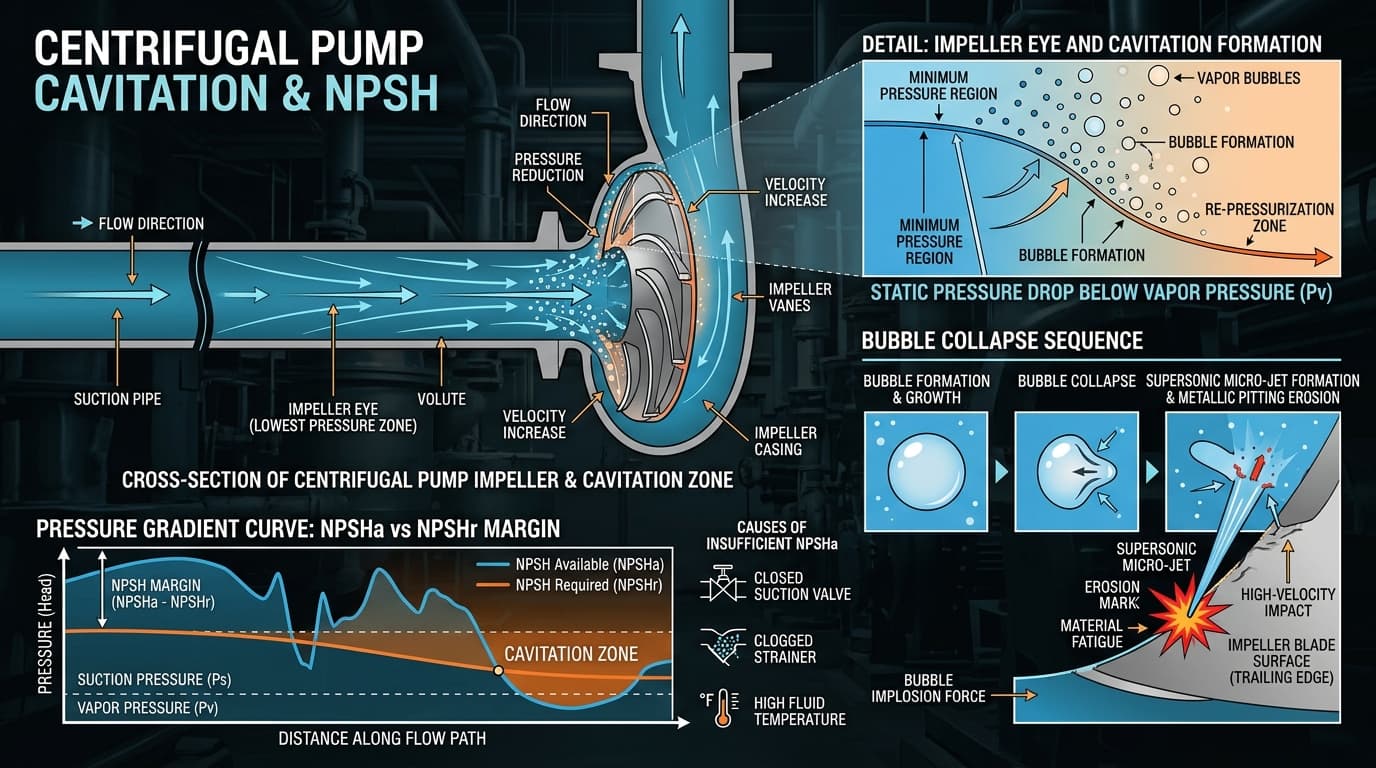
Figure 1: Cross-sectional mechanics of centrifugal pump cavitation: static pressure drop below vapor pressure, micro-bubble nucleation, supersonic micro-jet collapse, and localized pitting erosion.
The Number One Killer of Centrifugal Pumps
More than 60% of premature pump bearing and mechanical seal failures in processing plants are directly caused by cavitation. Understanding how to diagnose the acoustic signature and calculate your NPSH margin will save tens of thousands of dollars in annual maintenance shutdowns.
1. What is Pump Cavitation? The Microscopic Shockwave Physics
Most people assume water only boils when you heat it to 100°C (212°F). But thermodynamics dictates that boiling occurs whenever local static pressure drops below the fluid saturation vapor pressure (P_v) at that temperature.
As fluid enters a centrifugal pump, it accelerates rapidly into the narrow "eye" of the rotating impeller. By Bernoulli's principle, this sudden velocity spike causes a localized pressure drop. If static pressure plunges below vapor pressure, millions of microscopic vapor cavities (bubbles) instantly boil into existence.
Milliseconds later, as the liquid sweeps these bubbles along the impeller vane into regions of rising pressure, the vapor bubbles implode violently. Because the bubble collapses asymmetrically against the solid metal wall, a concentrated micro-jet of liquid fires inward at supersonic velocities exceeding 1,000 meters per second (over 3,200 ft/s)! Localized impact pressures exceed 10,000 bar (145,000 PSI), literally tearing microscopic chunks of metal right out of the impeller blade.
Audit Your NPSH Margin Online
Input your deaerator height, water temperature, and pipe diameter to check your exact NPSHa vs NPSHr safety margin automatically.
2. The 5 Telltale Warning Signs of Cavitation
1. The Distinctive "Pumping Gravel or Marbles" Noise
The most famous symptom. Cavitation does not sound like boiling water; it sounds like handfuls of river rocks or steel marbles being hurled against the inside of the pump volute casing. It is the acoustic shock of millions of micro-jets imploding against the metal.
2. High-Frequency Broadband Vibration
Vibration monitoring reveals a dramatic spike in high-frequency energy (1 kHz to 10 kHz). Unlike mechanical unbalance or misalignment which peaks at 1X or 2X running speed, cavitation generates a characteristic wide "haystack" noise floor.
3. Fluctuating Discharge Pressure & Drop in Head (3% Falloff)
When cavitation progresses, vapor bubbles begin choking the impeller throat passages. The pump can no longer impart full velocity to the fluid, causing discharge pressure gauges to flutter erratically and total head to drop.
4. Premature Mechanical Seal & Bearing Failures
Vapor bubble collapse creates severe uneven radial hydraulic thrust forces on the shaft. Mechanical seal faces separate, thermal shock damages silicon carbide faces, and thrust bearings overheat within weeks.
5. Swiss-Cheese Pitting Erosion on Impeller Vanes
During visual inspection after teardown, the suction side or trailing edge of the impeller appears spongelike, dull gray, and perforated with thousands of tiny craters.
3. The 4 Distinct Types of Cavitation
1. Classic Suction Cavitation (Inadequate NPSHa)
Occurs when the suction line pressure is too low, pipe diameter is undersized, or fluid is too hot. Bubbles form in the low-pressure impeller eye and collapse on the front face of the vanes.
2. Discharge Cavitation (High Head / Throttled Flow)
Occurs when the pump operates too close to its shutoff head against a closed valve. Fluid recirculates at extreme speeds through the narrow clearance between the impeller tips and the casing cutwater (volute tongue), creating localized vacuum voids.
3. Internal Recirculation Cavitation
Happens when the pump runs far to the left of its Best Efficiency Point (BEP). The angle of the incoming fluid no longer matches the blade inlet angle, causing flow separation, violent vortices, and vane damage on the pressure side.
4. Air Aspiration (Air Ingestion)
Technically not true vaporous cavitation, but causes identical symptoms. Air is drawn into the pump via weeping valve stem packings, vortexing in suction tanks, or low liquid submergence over the suction inlet pipe.
4. NPSHa vs. NPSHr: The Safety Margin Rule
To prevent cavitation, you must maintain a healthy positive margin between two terms:
- NPSHa (Available): Determined exclusively by your physical plant installation: tank elevations, surface pressures, fluid vapor pressure, and suction piping friction.
- NPSHr (Required): Determined exclusively by the pump manufacturer during hydraulic water testing per ISO 9906 / ANSI HI 9.6.1. It is the suction head at which the pump experiences a 3% head breakdown.
Per API 610 (12th Edition) Section 6.1.11, hydrocarbon and high-energy boiler feed pumps require a minimum NPSH margin of at least 1.0 meter (3.3 feet) or a 1.2x to 1.3x margin ratio across the full operating range from minimum stable flow to 120% of BEP.
5. How to Calculate NPSHa with Precision
The governing formula referenced to the pump suction nozzle centerline is:
Where:
- P_suction_vessel_abs: Absolute pressure on liquid surface (atmospheric pressure for open tanks + gauge pressure for closed vessels)
- P_vapor: Saturation vapor pressure of the fluid at the maximum operating temperature
- Z_static: Positive for flooded suction, negative for suction lift
- h_f_suction: Total friction loss through suction pipe, strainer, isolation valve, and elbows
6. 6 Practical Engineering Fixes for Inadequate NPSHa
Upsize the Suction Pipe Diameter by One Standard Size
Because friction drops with the 5th power of diameter (h_f ∝ 1/D^5), increasing a suction line from 3-inch to 4-inch cuts friction head loss by over 70%!
Elevate the Suction Vessel or Lower the Pump Foundation
Adding just 1.5 to 2.0 meters of physical vertical height directly injects 1.5 to 2.0 meters of fresh NPSHa into the system.
Install an Impeller Inducer (Axial Booster Stage)
An inducer is a miniature axial-flow screw fitted directly onto the impeller shaft immediately upstream of the main impeller eye. It raises local pressure by 2 to 4 meters, drastically lowering the pump NPSHr requirement.
Replace Restrictive Suction Valves & Strainers
Never install a globe valve or butterfly valve on a pump suction line. Use a full-port gate valve or full-bore ball valve. Upgrade to low-loss, high-open-area basket strainers.
Subcool the Feedwater (Lower Operating Temperature)
If water temperature can be trimmed from 90°C to 80°C, saturation vapor pressure drops from 0.70 bar down to 0.47 bar, adding 2.4 meters of immediate NPSHa cushion!
Reduce Rotational Speed via VFD
NPSHr decreases significantly at lower RPMs. Slowing the pump by 15% to 20% often eliminates cavitation entirely while matching reduced process demand.
7. Impeller Metallurgy: Bronze vs. 316SS vs. Super Duplex
When operating in harsh, near-cavitation conditions, metallurgy dictates how long the impeller will survive:
| Impeller Metallurgy | Cavitation Resistance Index | Typical Industrial Application |
|---|---|---|
| Cast Iron (ASTM A48) | 1.0x (Baseline - Poor) | Clean ambient water, HVAC non-critical |
| Tin Bronze / Aluminum Bronze | 2.5x to 4.0x | Seawater cooling, marine ballast |
| 316L Stainless Steel (CF8M) | 4.5x to 6.0x | Chemical process, boiler feed auxiliary |
| Duplex 2205 (CD3MN) | 8.0x to 12.0x | High-pressure deaerators, oil & gas API 610 |
| Super Duplex 2507 (CD4MCu) | 15.0x to 20.0x | Desalination, severe corrosive slurry cavitation |
8. Complete Cavitation Troubleshooting Matrix
9. Frequently Asked Questions
Can a pump cavitate if the suction pressure gauge reads positive?
Yes! Even if the suction gauge reads +1.0 bar, if your fluid is 115°C water (which has a saturation vapor pressure of 1.69 bar absolute), the fluid is already below vapor pressure and will flash into cavitation. Always compare absolute suction pressure to saturation vapor pressure, not atmospheric zero!
Does cavitation harm the pump motor?
Indirectly, yes. As vapor fills the impeller, flow and head plunge, causing motor current to oscillate erratically. Furthermore, the intense hydraulic vibration transfers directly through the shaft coupling into the drive-end motor bearings, causing mechanical fatigue.
Zylofy Thermal & Fluid Dynamics Engineering Group
Authored and reviewed by rotating equipment reliability specialists, vibration analysts, and plant commissioning consultants with hands-on diagnostic experience in petrochemical, utility, and municipal pumping systems.